The Sibling Thread
It wasn't the Revolutionary War that afforded us celebration for Independence Day. It was the hard-fought Pennsylvania Dutch pioneers who established the foundation in the decades before.

With our 250th Independence Day coming up this weekend, my mind has been wandering more and more to the likeness of old dirt roads, limestone bridges, and early pioneer farmsteads around Cumberland County, Pennsylvania. That’s where my dad’s side of the family is from: they are all Pennsylvania Dutch, through and through. In recent months, I’ve gone down the rabbit hole and become a bit of a family historian. Along the way, I learned about a specific angle of family history that was worth its weight in corn crops to share.
Before I start this story, though, I’ll mention the timing of my post this week is because of Independence day. I’ve noticed that around the Fourth, it’s easy to focus on the broader history textbook narratives: the flags that were waved, the declarations made, or the famous battles won. But what seems to be forgotten is the part that happened before all of that. The part where Europeans migrated to an early America after a long boat ride in the early 1700s. This is the real magic of America’s story that’s found in the quiet, stubborn ways that our ancestors navigated the wilderness, built a foundation, and eventually found their way back to each other generations later. These people were the true pioneers. And their stories can bring on a whole range of emotion, from excitement and fortitude to fear and tragedy.
For my family, this story belongs to the Clever and Hippensteel families of early Southampton Township, Cleversburg, and Shippensburg. It’s a tale about tough-as-nails pioneers, a revolution fought, a family tree that split into parallel branches, and a surprise family reunion under one roof about a century later.
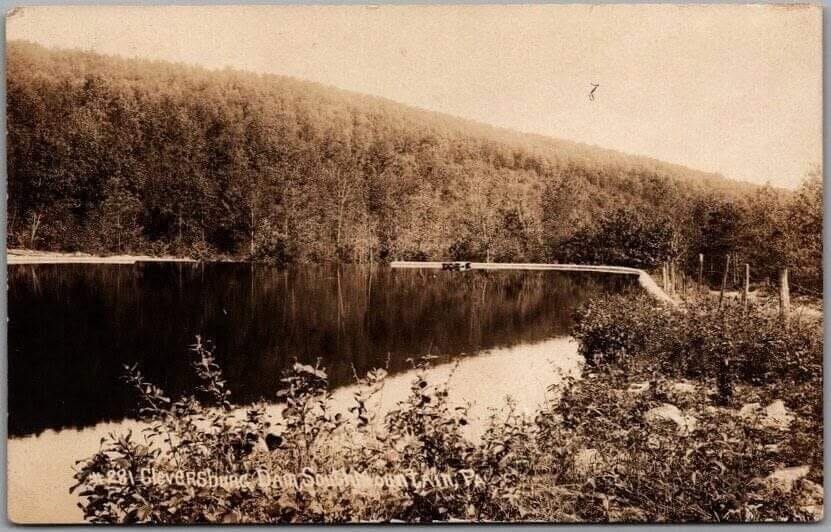
The Bedrock: The Sacrifice and Paper Trail of Michael and Ann Clever
Before you can have a revolution, you have to build a place worth fighting for. Sometimes, the story reveals those who had to pay for it with their lives. Long before the war drums of 1776 started beating, my 6th great-grandparents, Michael and Ann Clever, were born into the rugged, unrefined Pennsylvania landscape by parents who immigrated from Germany. They were a major component in the true foundation of our family history. Establishing their family within a wild, untamed frontier, Michael and Ann did the heavy lifting that history books often skip over. But they didn’t just clear the dense forests and break the rocky soil; they had to fight a mountain of colonial bureaucracy just to own the dirt under their feet.
Back in the mid-1700s, securing land wasn’t as simple as signing a modern deed. Michael and Ann had to deal directly with the Penn family’s land office, navigating the high-stakes world of colonial land warrants and proprietary surveys. They would’ve had to apply for a warrant, pay the Penn family proprietors, wait for a surveyor to physically mark the bounds out in the brush, and finally secure a land patent. Every acre of rich Pennsylvania soil represents a massive paper trail of grit and legal determination.
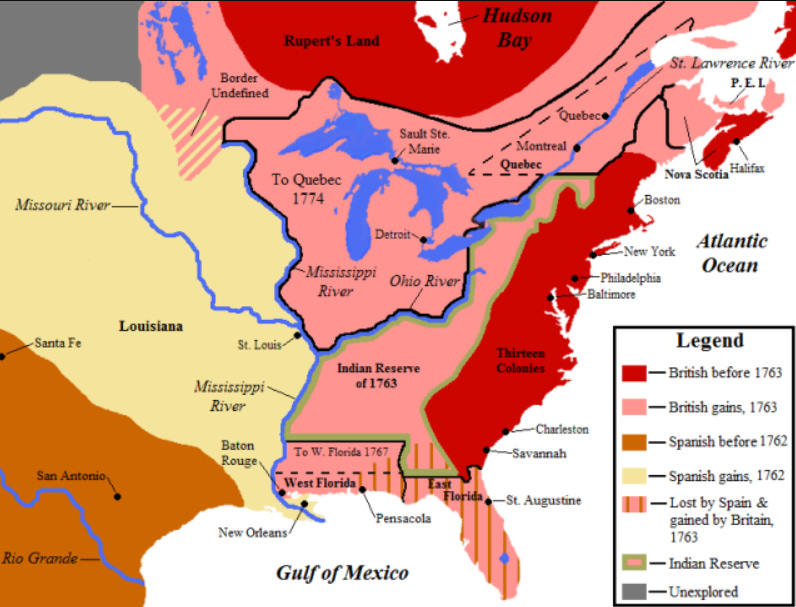
But their presence on that land carried an unimaginable risk. Because their hard-won property sat squarely within British colonial territory, they were positioned right on the dangerous, bleeding edge of a global conflict. In 1757, during the height of the French and Indian War, the geopolitical tensions of the frontier arrived at their doorstep. Michael and Ann were targeted, attacked, and tragically killed and scalped by Delaware Indians who were allied with the French.
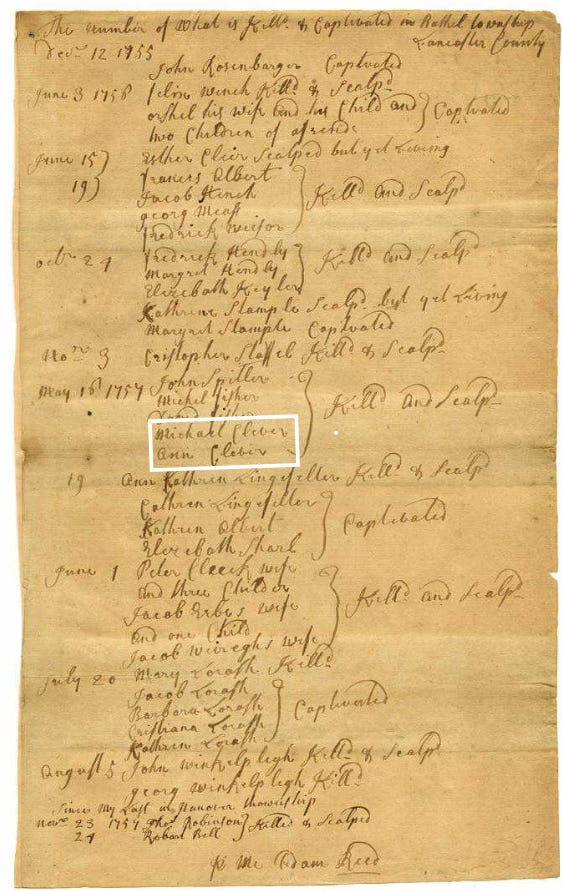
They made the ultimate sacrifice on the very soil they had fought so hard to legally claim. At the time, it was recorded that Ann appeared to be with child (her 12th). Three children were also captured, and those who escaped into the forest were later in wrapped up in a complicated custody agreement with their aunts and uncles.
From the Ashes of 1757 to the Line of 1776
When a family endures that kind of foundational tragedy, the land becomes more than just property—it becomes sacred ground. Michael and Ann’s young son, John Bernhardt “Barney” Clever (1747 - 1816), survived that terrifying frontier era along with several siblings. He grew up walking the very soil his parents died to protect, eventually transforming their hard-won foothold alongside his brother, Henry, into a thriving 240-acre homestead affectionately known as “Mansion Farm”.
When the call to arms echoed through Cumberland County in 1776 at the start of the revolutionary war, Barney’s decision to join the fight wasn’t just about abstract political philosophy or taxes on tea. For him, independence was deeply personal.
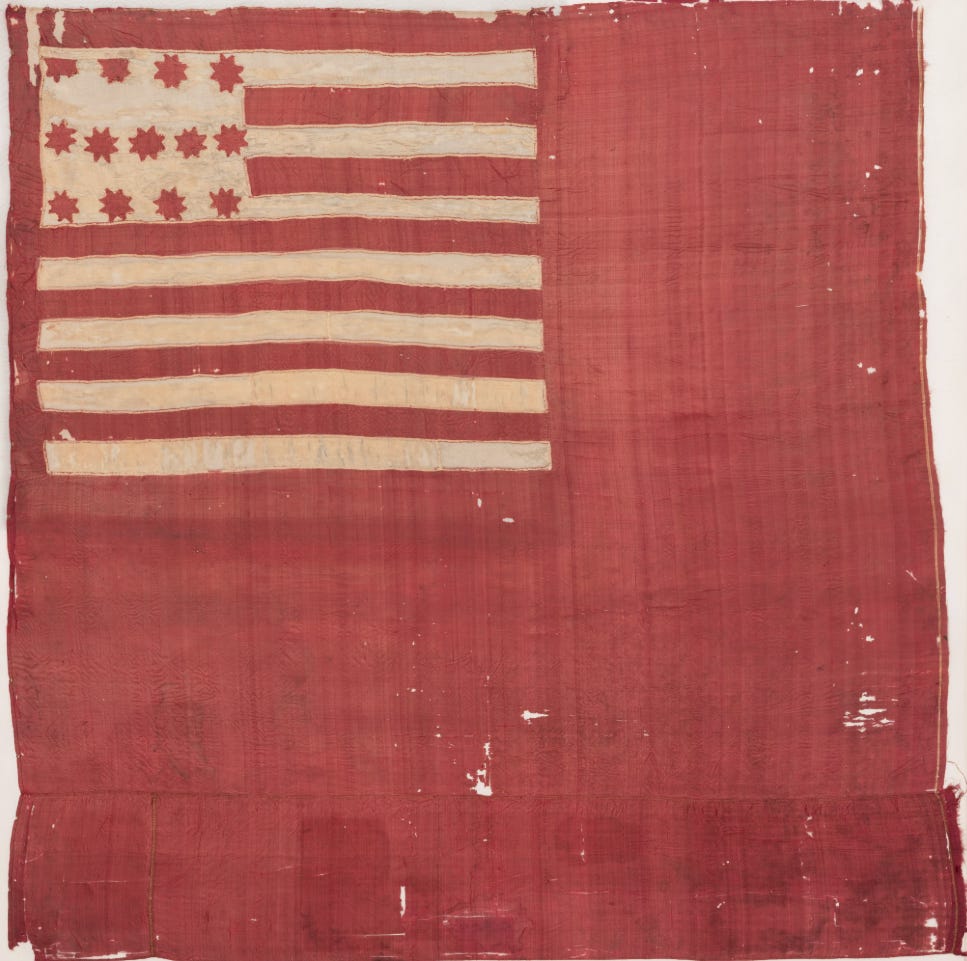
He stepped up as a Private in the 4th Company, 3rd Battalion of the Cumberland County Militia. These weren’t professional soldiers; they were ordinary farmers, blacksmiths, and neighbors charged with defending the Pennsylvania frontier while Washington’s Continental Army fought the British out east. They didn’t have uniforms or fancy guns. They had institutional knowledge, grit, and determination. Together, these Pennsylvania Dutch farmers dropped their scythes in exchange for weapons, they often didn’t even have formal uniforms to establish their batallion. When Barney stood on the militia line, he was defending the community his parents had carved out of the wilderness, ensuring that their ultimate sacrifice nearly a decade prior would not be in vain.
The Great Split: Sarah, Elizabeth, and George
When Barney passed away in 1816, he left behind a legacy of freedom, a massive tract of land, and a sprawling family tree. It’s right here, in the early 1800s, where my direct family lineage takes a fascinating turn, and where a clear distinction emerges between the branch of the family that built the town and the parallel branches that eventually led to me.
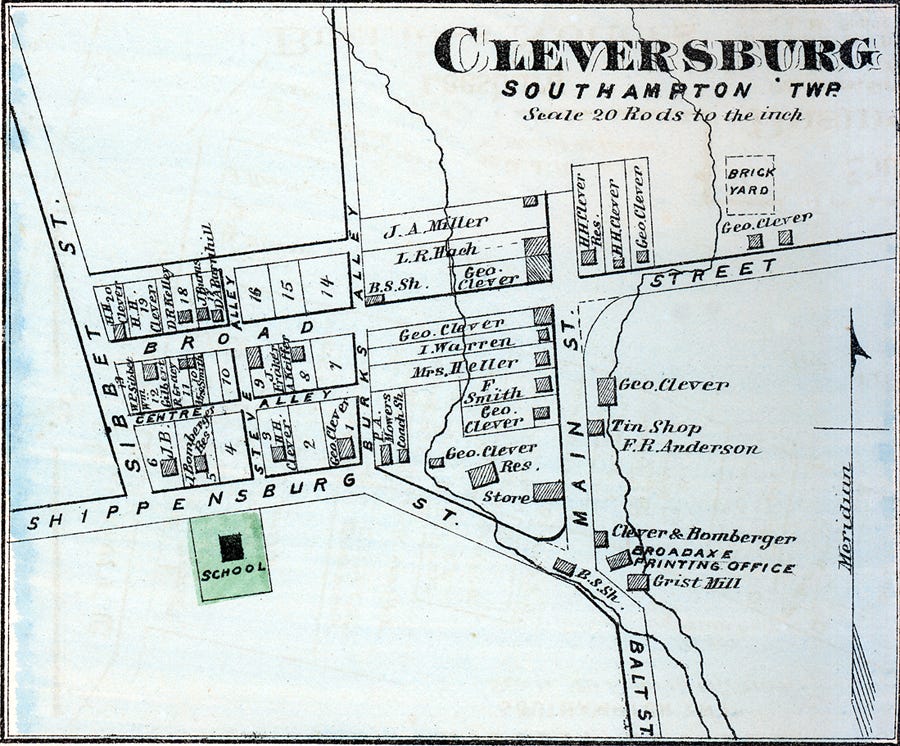
Barney’s son, George Clever Sr., inherited a deep commitment to the area, a trait he passed down to his own son, George Clever Jr. He also, by nature of being a man, inherited a lot of land and farm ownership built by the generation(s) before him. By the time George Jr. was in his prime around the 1870s, the property wasn’t referred to as “Mansion Farm” anymore, but it was still a massive, bustling operation boasting over 100 acres and a sprawling orchard. George Jr. was a true civic force: he built his prominent homestead right on the main crossroads, established a one-room schoolhouse for local children, and effectively put Cleversburg, Pennsylvania, on the map.
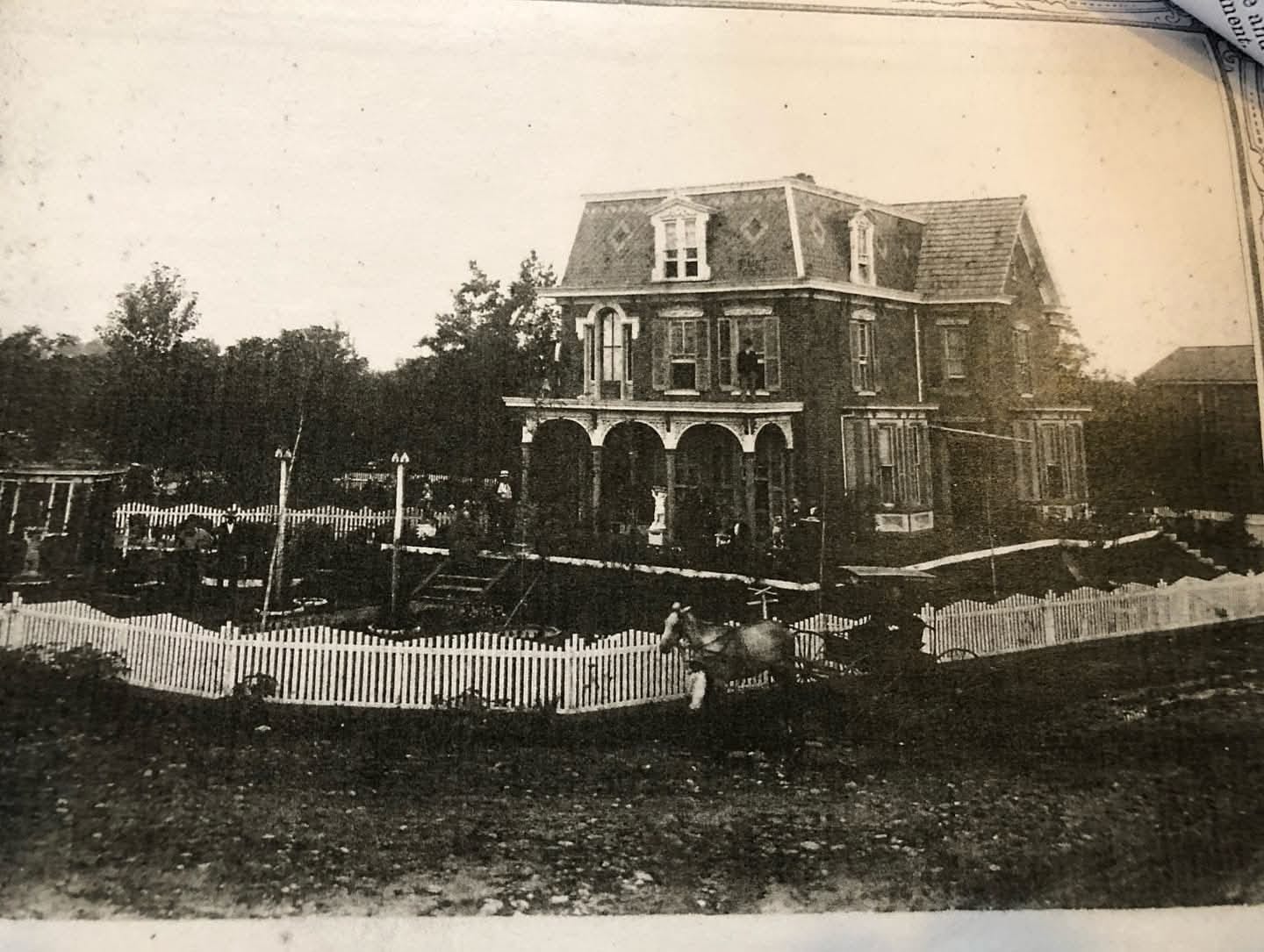
But while George Jr. was busy founding the town, my direct heritage was quietly moving down a entirely different set of parallel paths. I am not directly descended from the Georges in the Clever family. Instead, my bloodline runs through George Sr.’s sisters, otherwise positioned as Barney’s daughters: Sarah and Elizabeth Clever.
While their brother’s family built the town’s infrastructure, the sisters kept our direct lineage moving forward through a tightly woven network of neighboring families:
Elizabeth Clever married into the Varner family.
That Varner daughter, Susan, married into the Hippensteel family.
Sarah Clever married into the Helm family.
A daughter from the Helm line married a Myers.
A descendant from that Myers line eventually married back into the Hippensteel family.
Here’s where the map dated 1858 beautifully illustrates this neighborhood network. It shows the Clever family tracts sitting just west of the Hippensteel land, with the Varner and Helm acreage flanking them nearby, slightly to the north. For nearly a century, my direct ancestors lived as literal neighbors to their Clever cousins. They went to the same churches, traded at George Jr.’s store, and farmed the exact same limestone soil while their individual family branches drifted further apart, waiting for a future generation to loop them back together.
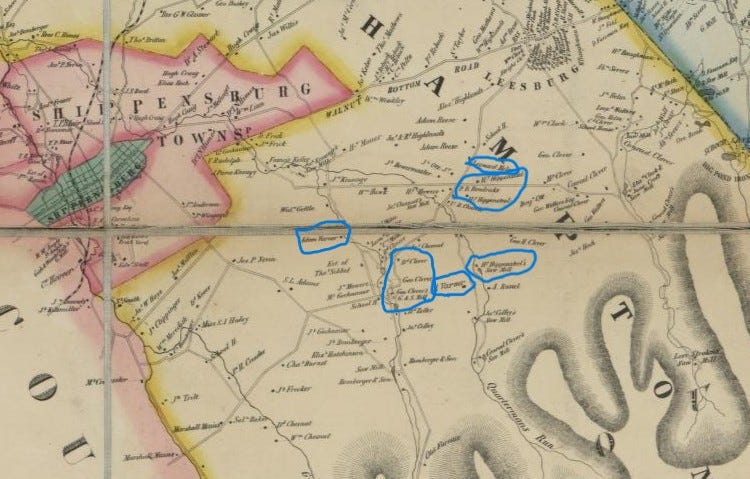
Clockwise from the top under the big “M” in South Hampton: Leonard Helm’s property, Bowmaster in between H. Hippensteel, A. Varner’s acreage, followed by Geo Clever’s largest circle, then Adam Varner again furthest to the west. All owned land just east of what became Shippensburg proper, Pennsylvania.
The 3rd-Cousin Loop: Closing the Circle
Families on the early American frontier had a funny way of looping back together. It makes sense, it’s not like they intentionally travelled very far to find a partner. Decades passed, the Civil War came and went (I have a Hippensteel family story there, too, for another time.), and America marched right into the 20th century. Barney Clever’s Revolutionary War service was now a distant family legend. But of course, the name lived on.
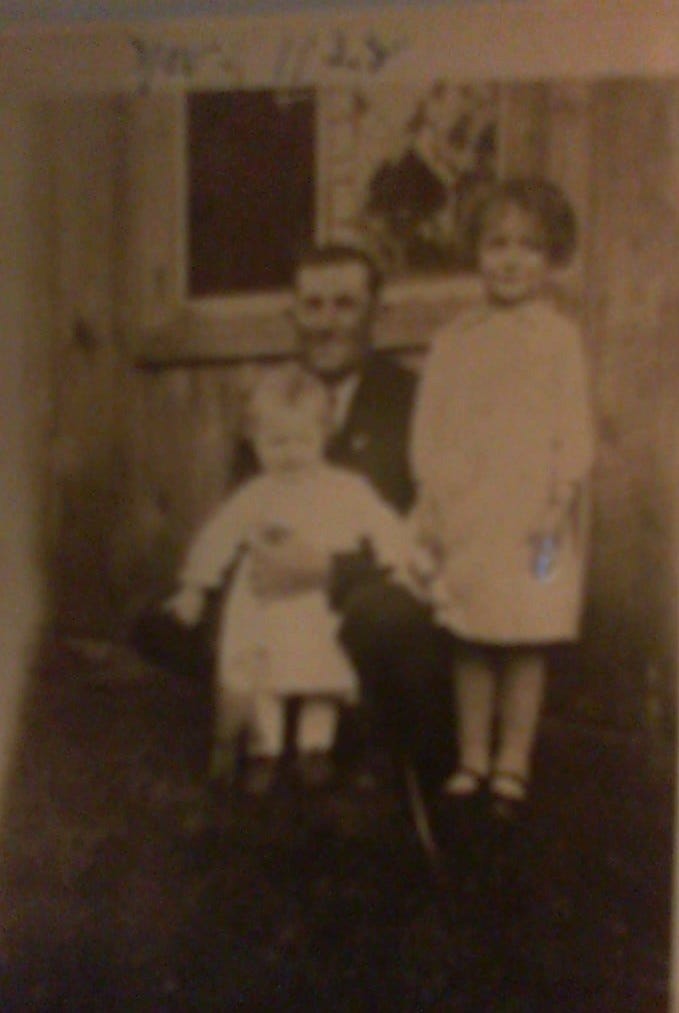
Then came John Franklin Hippensteel and Kathryn Myers.
John was the son of Joseph Cyrus Hippensteel and Emma Kunkleman. Kathryn was the daughter of Geary Myers and Mary Martha Forman. Separated by decades of geographic sprawl and different surnames, John and Kathryn met, fell in love, and decided to tie the knot.
What they probably just saw as a sweet neighborhood romance was actually a massive genealogical convergence. Mathematically, John and Kathryn were third cousins.
By establishing their own roots, John and Kathryn completely rewrote the map of my family tree. They took the separate lines that had branched away from those early Clever siblings a over a century prior, and looped them right back together under one roof.
What We Remember on the Fourth
So this Independence Day, when the fireworks light up the sky, I won’t just be thinking about the history textbooks, a romanticized historical fiction soundtrack to Hamilton, or a flag of red, white, and blue waving across the country.
Instead, I’ll be raising a glass to Michael and Ann Clever, who fought the colonial courts and paid the ultimate sacrifice to secure their piece of the frontier. I’ll hail a “cheers!” to Barney Clever, standing his ground with the Pennsylvania militia after incredible family hardship, and to Sarah and Elizabeth, for keeping our family line moving stubbornly forward while their brother made the Clever name memorable. And finally, I’ll be celebrating John and Kathryn, the third cousins who brought this entire, beautiful story full circle by parenting my paternal grandfather in the Pennsylvania Dutch-rooted towns of Shippensburg and Chambersburg, Pennsylvania.
This is the real story of the American dream. It wasn’t just won on distant battlefields by generals in oil paintings; it was woven together, generation by generation, on the porches and in the farmhouses of ordinary families just like ours.
Do you have any pioneer ancestors who settled your family’s favorite places before the Revolution? Let me know in the comments below!
Sources and Historical References:
Revolutionary War Service: John Bernhardt “Barnhart” Clever is an officially recognized patriot ancestor by the National Society Daughters of the American Revolution (DAR Patriot Index ID: A065926). His military service as a Private in Captain John Lamb’s 4th Company, 3rd Battalion of the Cumberland County Militia is verified via the Pennsylvania Archives, 5th Series, Volume 6, Page 225. [1]
Colonial Land & Pioneer Records: Information regarding the physical bounds, transfer, and family distribution of the 240-acre “Mansion Farm” estate in Southampton Township is preserved via the Cumberland County Will Abstracts & Deed Records (Book H, Page 422, proven August 6, 1816, and Deed of Release Record Book 1 GG, Page 335). [1, 2]
Early Pennsylvania Settlement Records: Details concerning the pre-Revolutionary footprint of John Michael Clever and family, including original pastoral registries tracking their early ties to Swatara and Lancaster County before migrating to Cumberland County, are documented through the Historical Records of Reverend John Casper Stoever. [1, 2]
Colonial Bureaucracy Framework: Historical context regarding the Penn family’s land processes—including applications, proprietary mapping, and physical surveys—is indexed through the Pennsylvania Historical and Museum Commission (PHMC) Land Office Records and the historic Warrantee Township Maps for Cumberland County. [1, 2]
Genealogical & Lineage Compilations: Family connections tracking the branches of Sarah Clever (Helm), Elizabeth Clever (Varner), the establishment of Cleversburg, and the later 20th-century alliance of John F. Hippensteel and Kathryn Myers are drawn from regional histories, including corporate research compiled in My Ancestors: The Goodharts and Clevers of Cumberland County, Pennsylvania (1966). [1]